|

Während des Ersten Weltkriegs gründete Herr Lucien Pictet die Waffenfabrik „La Précision“ in Genf, Schweiz. Herr Pictet war Geschäftsführer der Firma Piccard & Pictet, Hersteller von Pic-Pic-Autos. Um 1918 wurden die leerstehenden Fabrikgebäude von den beiden Genfer Ingenieuren Robert Fäsch und De Saugy genutzt, um mehrere große dreirädrige Prototypen von Bodenfräsen nach Konrad von Meyenburgs Patente zu bauen. Der Traktor war mit einem 25 PS starken 4-Zylinder-Motor von Rochet-Schneider, Frankreich, ausgestattet. Es hatte 3 Vorwärts- und 1 Rückwärtsgang, der Arbetitsbreite betrug 200 cm. Trotz einer positiven Bewertung durch eine Fachjury bei einem Pflugwettbewerb war eine Serienproduktion nicht möglich.

Sie stellten auch ein handgeführtes Modell her, für das sie eine Unterlizenz von A. Grunder & Co. erhielten. Es wurde von einem Motosacoche (später MAG) Zweizylinder-V-Motor angetrieben, wassergekühlt und mit 12 PS Leistung. Es ist bekannt, dass mehrere dieser Bodenfräsen in England überlebt haben. Obwohl die Serienproduktion fast aufgenommen werden konnte, hätten diese schweren, unhandlichen Maschinen die Firma „La Précision“ beinahe ruiniert. Erschwerend kommt hinzu, dass um 1920 kurz nacheinander die beiden führenden Ingenieure Fäsch und De Saugy starben.
In England lieferte SIMAR (eine Nachbau von ?) Grunder 2 PS Bodenfräsen als SIMAR Type 4.
Die Leitung von „La Précision“ wurde von Herrn Léon Dufour übernommen, dem ehemaligen technischen und geschäftsführenden Direktor des Automobilkonzerns Piccard & Pictet. Der Firmenname, der an die Waffenproduktion erinnerte, wurde nicht mehr als angemessen angesehen, um die neuen Landmaschinen zu empfehlen. Léon Dufour stellte zunächst den neuen Firmennamen Société Industrielle de Machines Agricoles Rotatives SA (Industrieunternehmen für rotierende Landmaschinen), kurz SIMAR SA, mit Sitz in Genf.
Das neue Unternehmen stellte die Entwicklung schwerer und teurer Ackerschlepper ein und wandte sich stattdessen handlicheren und billigeren Maschinen zu. Sie begannen, die Bedürfnisse der zukünftigen Käufer zu recherchieren, bevor sie etwas produzierten. Im Sommer 1922 wurde die Produktion an den Chemin de Lancy, noch in Genf, verlegt.

Weder Mühen noch Kosten wurden gescheut, um eine kleine handgeführte Bodenfräse zu entwickeln, die eine große Anzahl von Kunden anziehen würde. Das Ziel konnte durch den Bau kleiner Zweitaktmotoren („Grunder-System“) erreicht werden, die durch einen Lüfter am Schwungrad gekühlt werden. Diese führten schließlich zu den gewünschten Ergebnissen. Von 1927 bis 1931 wurden über 2500 SIMAR C2 Bedenfräsen ausgeliefert, in den Jahren 1932 und 1933 sogar 3000.
Das deutsche Unternehmen Siemens-Schuckert erwarb die Fertigungsrechte und platzierte zudem einen Großauftrag über fertige SIMAR-Bodenfräsen. Diese wurden in Deutschland unter der Marke Siemens verkauft, während sie das größere Modell selbst herstellten. Da Siemens seine Abteilung Bodenfräsen später an Bungartz aus München verkaufte, stoppte SIMAR Mitte der 1930er Jahre seine Exporte nach Deutschland. Bungartz stellte seine eigenen Bodenfräsen, die Bungartz L3 war speziell als Ersatz für die SIMAR gedacht.

SIMAR Nr. 10, mit einem 8 PS starken Zweitakt-Benzinmotor. Diese Bodenfräse wurde in Deutschland von Siemens als S oder Plantagenfräse verkauft.
Ab 1927 begann René Moser mit dem Werkshandel für SIMAR-Bodenfräsen in England, Italien, Australien, Südafrika und den USA. Seine effizienten Marketingstrategien reaktivierten die rückläufigen Umsätze in den USA und es konnte ein beeindruckendes Händlernetz unter der Marke Rototiller aufgebaut werden. Es wird berichtet, dass um 1930 28 SIMAR 8-PS-Motorhacken in öffentlichen Gärten und Parks in New York City eingesetzt wurden. SIMAR-Bodenfräsen wurden auch in England (von Geo. Monro Ltd.) und den USA (von C.W. Kelseys Rototiller Company) in Lizenz hergestellt.
Gegen 1933 kehrte der sehr aktive Auslandsvertreter René Moser nach Genf zurück und erwarb die Aktienmehrheit der Firma SIMAR SA. Sämtliche Patentrechte blieben Eigentum von Léon Dufour.

Trotz des Erfolgs der handgeführten Bodenfräsen waren die beiden Ingenieure Dufour und Moser immer noch begierig darauf, mit Vierradtraktoren zu experimentieren. Ab 1936 führten sie mehrere Konstruktionen durch, um einen Einachsschlepper in einen Traktor umzuwandeln. Der gesamte Teil Motor-Getriebe-Fräse könnte sich um die Hinterradachse drehen, um den Anbau der Fräse anzuheben und zu senken. Nach vielen verschiedenen Prototypen konnten bis 1955 160 SIMAR-Traktoren der Modelle T100A und T100B hergestellt werden. Das Hauptproblem bestand darin, die richtige Arbeitstiefe in unebenem Gelände einzuhalten. Um dieses Problem zu lösen, wäre eine völlig neue Hebekonstruktion nötig, aber da die Ferguson-Patente bald auslaufen würden, schien dies nicht lohnenswert. Die komplette Geschichte der SIMAR-Traktoren, mit vielen Fotos der verschiedenen Prototypen, ist im Buch Schweizer Traktorenbau, Band 3 beschrieben.
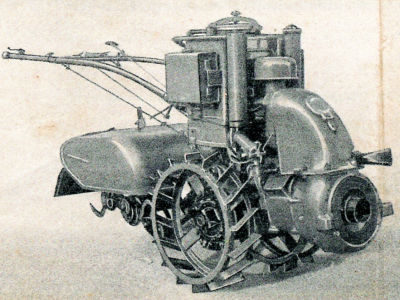
Wegen Benzinmängel während dem 2. Weltkrieg entwickelte Bungartz & Co., München zusammen mit SIMAR eine Spezial-Acetylen-Bodenfräse auf Basis der 1940 bis 1943 gefertigte SIMAR 55A. Der Niederdruck-Acetylen-Generator entwickelte ausreichend Acetylengas für eine Motorleistung von 6 PS. Statt dem Vergaser hatte der Motor einem Gasmischer, darin das Gas befeuchtet und mit den nötigen Ölzusatz versehen wurde.
SIMAR entwickelte und produzierte weiterhin bis 1978 Einachsschlepper in vielen verschiedenen Modellen, über 50.000 Bodenfräsen verließen das Genfer Werk. Weitere Einzelheiten zu SIMAR finden Sie auf Donald A. Jones‘ Website. Ich habe einen Brief vom 24. Juni 1985, in dem sich eine Firma Mégevet-SIMAR SA mit Sitz in Carouge/Genf als metallurgische Fabrik profiliert, die auf Oberflächenveredelung vom Prototyp bis zur Serienproduktion, allgemeine Mechanik, Blechbearbeitung, Schweißen, Lackieren und Mechanik spezialisiert ist Maschinenbau, Pressarbeiten und Verzahnungsbearbeitung.
Quelle unter anderem: "Schweizer Traktorenbau" Band 3, Manuel Gemperle und Hermann Wyss, Seiten 346-347.

Französische Website mit vielen Informationen zur SIMAR-Landmaschinen


"Ich dachte, Ihnen könnten diese Bilder eines SIMAR Typ 4 Rototillers gefallen, der kürzlich vollständig gefunden wurde. Erstaunlicherweise sind bis auf die Motorventile alle Teile frei. Nach vielen Recherchen ist es die Maschine, welche in der Fruit Grower-Werbung von 1938 erschien. Sie ist jetzt im Besitz von The Hall & Duck Trust, da sie zu einer größeren Sammlung von Rasenmähern gehörte, die das Hall & Duck Trust jetzt besitzt."
Andrew Hall Trustee (aus Englisch übersetzt)


Charlie Moore hat die Überreste eines englischen SIMAR Typ 4, Nr. 3083, geborgen. 72, ursprünglich geliefert von Piccard-Pictet & Co. (London) Ltd. Motor-Nr. 18155 ist in den Motor eingeprägt. Wahrscheinlich aus dem Jahr 1919.

 Charlie Moore, Sekretär des VHGMC, entdeckte diese alte Bodenfräse auf dem Gelände des Wissenschaftsmuseums in Wroughton, in der Nähe von Swindon (England) im Jahr 2007. Dies ist das Überlauflager für die Exponate, die auf ihre Konservierung warten, und für diejenigen, für deren Ausstellung am Londoner Standort kein Platz ist. Vermutlich auch ein SIMAR Typ 4.

 David Muster (Schweiz) hat diesen SIMAR M10 Nr. 2069, hergestellt im Jahr 1928, in seiner Bodenfräsensammlung.

 David Muster besitzt auch diesen SIMAR M11 Nr. 3083, von 1930.


Geo. Monro Ltd. verkaufte die SIMAR-Bodenfräsen in England unter dem Namen Rototiller.
Anzeige aus der Zeitschrift „The Fruit-Grower“, 24. November 1938. Sammlung von Charlie Moore.

Charlie Moore (England), 2004. Die Maschine mit dem wassergekühlten V-Twin hat den Kühler hinter dem Motor und dem Kraftstofftank oben und ist in sehr schlechtem Zustand, Magnetzünder und Vergaser fehlen beide. Sie ähnelt der sehr frühen Maschine von 1919, die in Donald Jones‘ Buch vorgestellt wird, oder wahrscheinlicher der SIMAR, die auf der SIMAR-Geschichtsseite vorgestellt wird.

Charlie Moore (England), 2004. Die große wassergekühlte Einzylindermaschine ist eine SIMAR M11 mit Luftfilter vor dem Kühler und dem Abgasschalldämpfer auf der linken Seite des Motors. Der Bodenfräse wird derzeit restauriert.

Jim Readings (England) 1985. SIMAR M7, nr. 514, der Motor ist ein MAG 2C 20 9VM 57344, Baujahr ist 1930 (laut einem SIMAR-Beamten). Aber 1920 wäre wahrscheinlicher.

F&HEC Jan./Feb. 1995: Verkauf bei Vince Collection, Royal Norfolk Showground, Norwich, 15. Okt. 1994. Dieser in der Schweiz gebaute SIMAR Bodenfräse brachte 300 GBP ein. Komplett mit Ersatzzinken.

Museum Historische Landbouwtechniek, Wageningen (Niederlande), 1996. SIMAR M10, Nr. 1636 aus dem Jahr 1925. Es wurde von Boeke Heesters (dem niederländischen SIMAR-Importeur) restauriert und dann dem Museum gespendet.
Da das Museum geschlossen wurde, konnte Diego Verschuere aus Belgien diese Maschine 2008 seiner Sammlung von SIMAR-Bodenfräsen hinzufügen.


Fa. Van der Waal, Rijsoord (Niederlande). SIMAR M10 ?

SIMAR M10 Nr. 1135, hergestellt im Jahr 1923. Der Besitzer ist Brian Sherlock, Australien. Er sucht nach Platz und Geld, um sie zu restaurieren ...

|